

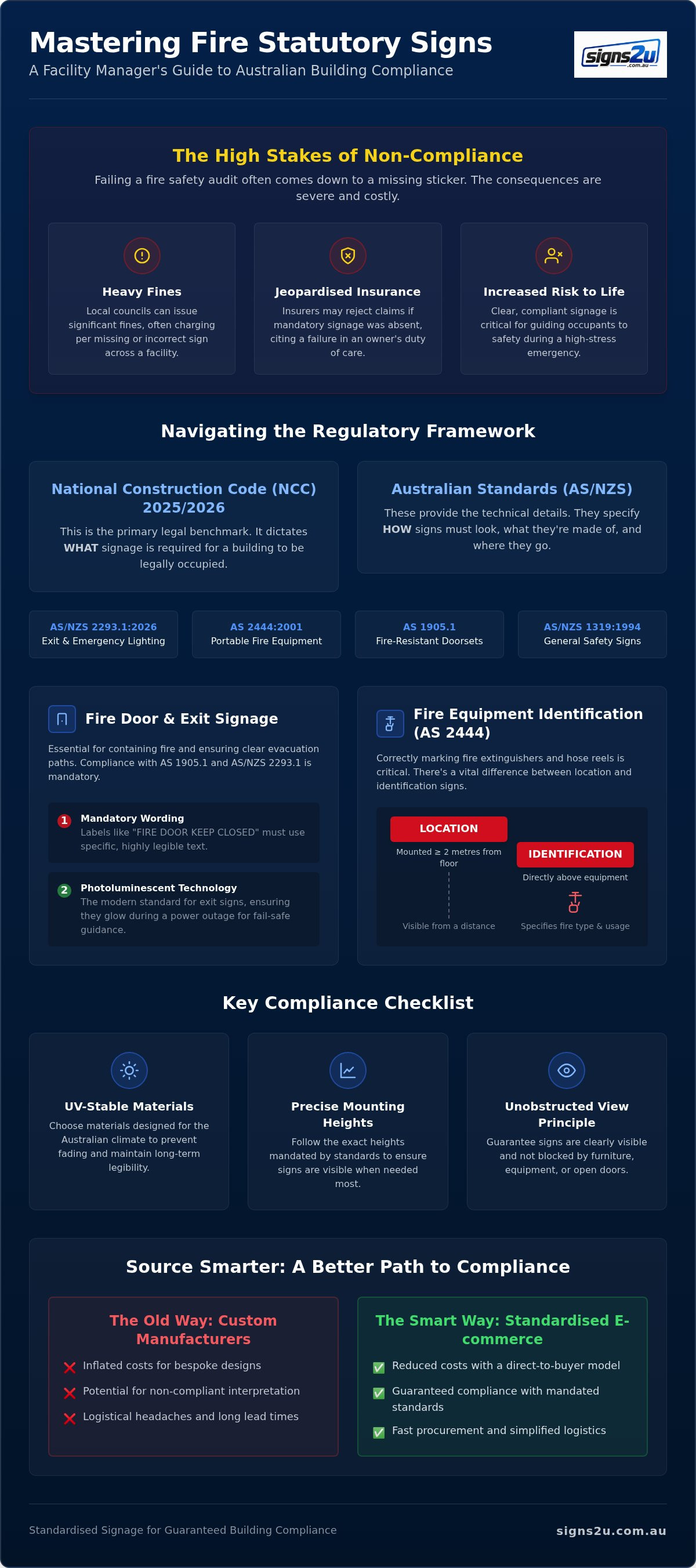
Failing a fire safety audit often comes down to a missing sticker rather than a total system failure. It's a common frustration for facility managers who find the overlap between the National Construction Code (NCC) 2025/2026 and Australian Standards like AS/NZS 1319:1994 a confusing maze. You shouldn't have to risk heavy fines or overpay for custom-designed signage when standard, compliant versions are all you need to satisfy a building inspector and ensure occupant safety.
This guide helps you master the specific requirements for fire statutory signs australia, ensuring you secure the right labels to protect your facility and your bottom line. We'll clarify the mandatory signs required under the latest AS/NZS 2293.1:2026 updates, explain the difference between NCC and state-based variations, and provide a clear path to achieving 2026 building compliance. You'll learn how to avoid legal liability through proper placement and how to procure high-quality, standardised signs quickly without the typical logistical headaches or inflated costs of bespoke manufacturing.
Key Takeaways
- Understand how the NCC 2025/2026 updates dictate mandatory signage benchmarks for building occupancy and legal safety compliance.
- Identify the essential fire statutory signs australia requires for stairwells and exits to ensure your facility passes its annual fire safety statement.
- Choose UV-stable materials designed for the Australian climate to prevent fading and maintain long-term visibility for all fire equipment markers.
- Apply precise mounting heights and "unobstructed view" principles to guarantee your signage meets strict Australian Standards for installation.
- Save time and reduce costs by sourcing standardised signage through a direct-to-buyer e-commerce model rather than expensive custom manufacturers.
Understanding Fire Statutory Signs and Australian Building Compliance
Statutory signs aren't optional decorations for a new build or office fit-out. They're mandatory markers required by law to ensure a building is safe for occupancy. In the context of fire safety, these signs provide critical information to occupants and emergency services during a crisis. Fire statutory signs australia must be installed correctly before a building surveyor can issue a final certificate of occupancy or an annual fire safety statement.
The National Construction Code (NCC) 2025/2026 serves as the primary regulatory benchmark. It dictates exactly which signs your facility needs based on its size, use, and complexity. Fire auditors check for these signs first during inspections because they're high-visibility indicators of a building's overall compliance health. If the basic signage is wrong, it often signals deeper issues with the fire safety management system.
It's vital to distinguish between different regulatory requirements. While Australian safety sign standards under AS 1319:1994 cover general workplace hazards, fire-specific equipment follows different rules. For example, AS 2444:2001 (reconfirmed in 2021) specifically governs the location and labelling of portable fire extinguishers and fire blankets. Mixing up these standards can lead to an immediate audit failure.
The Legal Framework: NCC and Australian Standards
Australian building regulations follow a strict hierarchy. The NCC provides the broad legal requirement, while specific Australian Standards like AS/NZS 2293.1:2026 provide the technical specifications for items like exit signage. Following these standards exactly is essential for legal protection. Choosing standardised signs is always better than ordering custom designs. Standardised signs use the precise symbols, colours, and font sizes mandated by law, leaving no room for interpretation by an inspector.
Definition: Fire statutory signs are mandatory building markers required by the National Construction Code and Australian Standards to ensure legal occupancy and occupant safety.
Consequences of Non-Compliant Fire Signage
Ignoring signage requirements carries heavy risks. Local councils and fire authorities have the power to issue significant fines for non-compliance, often charging per missing or incorrect sign. These costs add up quickly across a large facility. Beyond immediate penalties, missing signs jeopardise insurance coverage. If a fire event occurs and mandatory signage was absent, an insurer might argue the building owner failed their duty of care, potentially leading to a rejected claim. Most importantly, non-compliant signs increase the risk to life. During an evacuation, clear and familiar signage prevents panic and guides occupants to safety when every second counts.
Essential Types of Fire Statutory Signage for Your Facility
Every commercial building in Australia requires a specific inventory of markers to manage fire risks and guide emergency services. These aren't suggestions. They're legal requirements for building occupancy. Procurement usually starts with identifying high-traffic areas like stairwells, exits, and fire equipment storage points. Using the correct fire statutory signs australia ensures your facility remains compliant with the National Construction Code (NCC) 2026.
Fire Door and Exit Signage Requirements
Fire doors act as a primary barrier against smoke and flame. For these to function, they must remain closed or clear of obstructions. AS 1905.1 and the NCC 2026 specify the exact wording for these labels. You'll commonly see "FIRE DOOR KEEP CLOSED" or "FIRE DOOR DO NOT OBSTRUCT" in bold, legible lettering. In modern builds, there's a significant shift toward photoluminescent exit signs under AS/NZS 2293.1:2026. These glow-in-the-dark markers provide a fail-safe during power outages without relying solely on battery-backed electrical systems. Finding compliant fire door signs australia is a straightforward way to tick off this major audit item.
Fire Equipment Identification: AS2444 Standards
AS 2444:2001 mandates how we identify fire extinguishers and hose reels. There's a critical distinction between "location" and "identification" signs. A location sign is mounted high, usually 2 metres from the floor, to be seen from a distance or over obstacles. An identification sign sits directly above the equipment and details the type of fire it can handle. For extinguishers, this involves specific colour coding: red for the sign background with a white symbol. Using standardised fire extinguisher signs ensures the symbol matches the class of fire and satisfies the building surveyor.
External walls require high-visibility markers for hydrants and sprinkler booster connections. These are essential fire statutory signs australia inspectors look for to ensure the fire brigade can locate water supplies immediately. These signs must be made from UV-stable materials to prevent fading in the harsh sun. This ensures they remain legible for years, even in exposed industrial environments.
If you're preparing for an upcoming audit, you can buy statutory signs online to find exactly what your project requires without the custom-build price tag.
Selecting the Right Materials for Durability and Visibility
Choosing materials for fire statutory signs australia involves balancing upfront cost with environmental endurance. Signs aren't just markers; they're functional tools that must remain legible for years under varying conditions. If a sign fades or peels, it fails to meet the visibility requirements of AS 1319:1994, which can lead to a failed fire safety audit. Material selection should be dictated by the installation location and the level of physical wear expected in that area.
Self-adhesive vinyl is a pragmatic choice for internal fire doors and smooth surfaces. It's low-profile, easy to clean, and resists peeling in climate-controlled corridors. For external brickwork or industrial fencing, rigid plates are necessary. These provide a flat, stable surface that won't ripple or degrade when exposed to rain, wind, and temperature fluctuations. External signs face extreme heat and UV radiation, making UV-stable inks and substrates mandatory for fire hydrant or sprinkler booster markers.
Aluminium vs UV-Stable Plastic
Aluminium is the preferred choice for high-traffic areas and external installations. It offers superior corrosion resistance and won't crack under physical impact. It's the most durable option for buildings in coastal environments where salt air can degrade lesser materials. High-impact UV-stable plastic serves as a cost-effective alternative for internal office corridors where the environment is stable. For installation, use centre-mounting techniques like industrial-strength adhesive tape for plastic or mechanical fasteners for aluminium to ensure the sign remains level and secure.
Photoluminescent and Reflective Requirements
The NCC 2026 mandates photoluminescent signage for exit paths in many building classes. These glow-in-the-dark signs absorb natural or artificial light and remain visible during total power failure. External fire equipment often requires reflective backgrounds. This helps fire crews locate water supplies at night using torches or vehicle headlights. Signs2u organises these categories logically; this allows you to select by material and compliance type without the confusion of custom manufacturing. Using the correct fire statutory signs australia ensures your facility remains compliant with the latest safety standards.
Maintenance is simple but essential for long-term compliance. During your annual fire safety audit, wipe signs with a damp cloth to remove dust and grime. Check for mechanical damage or fading. Legibility is a legal requirement. If a sign is scratched or the text is illegible, replace it immediately to avoid liability and ensure occupant safety during an emergency.
Compliance Checklist: Correct Placement and Installation Rules
Buying compliant fire statutory signs australia is only the first step toward building safety. Correct installation determines whether your facility actually passes its annual fire safety statement. A sign tucked behind a door or mounted too low is as useless as no sign at all. Australian Standards are very specific about where these markers must sit to ensure they remain visible during an emergency.
The "unobstructed view" principle is a frequent point of failure in audits. This rule requires that fire equipment markers remain visible from all approach angles. In long corridors, flat signs are often insufficient. Use "L-shaped" or "V-shaped" projecting signs that stand out from the wall. These allow occupants to identify fire extinguishers or hose reels from a distance, even when moving through a crowded or smoke-filled hallway. If a door opens and hides a sign, it is non-compliant.
Fire doors require signage on both sides. A "Fire Door Keep Closed" label on just one side doesn't satisfy the NCC. If the door is part of a fire-isolated stairway, the signage requirements become even stricter regarding font size and placement. Always check that signs aren't obscured when the door is held open by magnetic releases or manual wedges. Consistency across the facility is the key to passing inspections without delays.
Mounting Heights and Viewing Distances
Most fire equipment location signs follow the 2-metre rule. Mount these high enough to be seen over people, furniture, and storage racks. However, the physical size of the sign must match the viewing distance. A sign intended to be read from 15 metres away has different dimensions than one required for a 30-metre warehouse span. Audit failures often happen because facility managers buy the smallest option without considering the scale of the room. Never mount signs on the equipment itself. They must be on the wall or a permanent fixture above the device.
Maintaining Signage Integrity
Compliance isn't a "set and forget" task. Signage integrity must be reviewed during quarterly or annual inspections. Faded, cracked, or peeling signs must be replaced immediately to maintain legal compliance. For large facilities, keep a signage register that lists the location, material, and type of every sign on-site. This makes procurement simple when a single marker is damaged. You can order replacement fire statutory signs directly to keep your register up to date and your building ready for inspection.
Sourcing Affordable Statutory Signs Online with Signs2u
Procuring compliance hardware shouldn't be an administrative hurdle. Traditional signage companies often focus on custom projects, which leads to long lead times and inflated costs for simple markers. Signs2u removes this friction by providing a direct-to-buyer e-commerce platform. This model ensures you get standardised fire statutory signs australia without the bespoke price tag. It's an efficient solution for projects where speed and compliance are the only priorities.
Standardised signs are the fastest way to achieve building certification. Because these signs follow the exact specifications of the NCC 2026, there's no need for custom design proofs or lengthy consultations. You select the required items from a digital catalogue and move straight to checkout. This streamlined path reduces project lead times significantly, allowing you to meet audit deadlines with confidence. It's a pragmatic approach that respects your schedule and budget.
Direct-to-Site Delivery Across Australia
Managing multiple sites requires a logistics partner that understands the value of time. Signs2u provides national delivery, ensuring that whether you're managing a single office or a national portfolio, your compliance gear arrives where it's needed. The no-nonsense shipping process is designed for busy property managers who need a "set and forget" procurement method. You don't have to visit a physical store or wait for a sales representative to call you back. Bulk orders are processed centrally, ensuring consistency across every floor of your facility.
Streamlined Procurement for Property Managers
The online catalogue is organised by compliance category, making it easy to find all required fire statutory signs australia in one session. This logical arrangement prevents the common mistake of missing a specific marker required by an auditor. While competitors might push expensive tactile or custom-etched options for every door, Signs2u focuses on utility. Standardised signage is almost always the most cost-effective way to secure legal protection and pass inspections.
Choosing a specialised provider means you're working with a partner that understands the Australian regulatory landscape. It's about getting the job done right the first time. Avoid the delays of custom manufacturing and secure your building's safety today. Browse the full range of fire statutory signs at Signs2u to finalise your compliance requirements and protect your facility from unnecessary liability.
Secure Your Building Compliance for 2026
Navigating the transition to NCC 2026 and updated Australian Standards doesn't have to be a logistical burden. Building compliance relies on two factors: choosing the correct standardised designs and ensuring precise installation. By focusing on UV-stable materials for external markers and photoluminescent signs for exit paths, you protect both your occupants and your legal standing. A missing or faded label is often the primary reason for a failed fire safety audit.
Ensuring your facility has the correct fire statutory signs australia requires is a straightforward process when you use a dedicated provider. You can avoid the high costs and long lead times of custom manufacturing by selecting from a catalogue of pre-approved, compliant designs. This pragmatic approach allows you to focus on managing your facility while the hardware is handled efficiently.
Signs2u offers a simple online ordering system designed for busy managers who need a reliable compliance partner. With NCC and Australian Standard compliant designs and cost-effective national shipping, getting your site ready for inspection is faster than ever. Shop Compliant Fire Statutory Signs at Signs2u today and secure your building's future with confidence.
Frequently Asked Questions
What are the mandatory fire signs required for a commercial building in Australia?
Mandatory signs include fire door labels, exit signs, and equipment markers for extinguishers and hose reels. The specific mix depends on the NCC 2026 classification of your building. You'll generally need hydrant and sprinkler booster identification on external walls and floor level signs in stairwells. These fire statutory signs australia must be installed to ensure the building is legal for occupancy and safe for all occupants.
Do fire exit signs need to be photoluminescent under the current NCC?
Photoluminescent exit signs are an approved alternative to powered electrical signs under the NCC 2026 and AS/NZS 2293.1:2026. While not mandatory for every building type, they're highly recommended for fail-safe performance during power outages. These signs absorb light during normal operation and glow in total darkness. They're often preferred for modern builds because they don't require battery-backed wiring, which reduces long-term maintenance costs for property managers.
What is the standard height for mounting fire extinguisher signs?
Fire extinguisher location signs must be mounted at a height of at least 2.0 metres from the floor level. This ensures the sign remains visible from a distance even in crowded spaces or warehouses with high shelving. The identification sign, which details the class of fire the unit handles, sits directly above the extinguisher itself. Proper mounting height is a critical check during annual fire safety audits to ensure compliance with AS 2444:2001.
Is Braille mandatory on all fire statutory signs in Australia?
Braille and tactile characters are mandatory for certain signage under the NCC and AS 1428.1, specifically for exit signs and floor level markers in fire-isolated stairways. However, standard fire equipment markers like extinguisher or hose reel signs don't usually require Braille. It's essential to check the specific requirements for your building class to determine which fire statutory signs australia require tactile elements to meet disability access and safety standards.
What is the difference between AS1319 and AS2444 signage?
AS 1319:1994 covers general safety signs for the occupational environment, including danger, warning, and emergency information signs. AS 2444:2001 is a specific standard for the selection and location of portable fire extinguishers and blankets. While AS 1319 provides the design framework for symbols and colours, AS 2444 dictates the technical placement and identification requirements for fire-fighting equipment. Both standards must be followed to achieve full building compliance during a safety inspection.
Can I install fire statutory signs myself or do I need a professional?
You can physically install the signs yourself, but they must be placed in strict accordance with Australian Standards and the NCC. Many facility managers choose to purchase standardised signs from an online retailer and handle the installation using internal maintenance teams. It's important to remember that while the physical act of mounting a sign is simple, the location and height must be precise to pass a fire safety audit.
How often should fire safety signs be inspected for compliance?
Fire safety signs should be inspected at least once every six months as part of your routine building maintenance schedule. During these checks, you must ensure that signs are still legible, haven't faded due to UV exposure, and remain unobstructed by new furniture or equipment. If a sign is damaged or missing, it must be replaced immediately. Keeping a signage register helps track these inspections and simplifies procurement when replacements are needed.
What size should a fire door sign be to meet Australian Standards?
The size depends on the required viewing distance, but standard internal labels are often 300mm x 75mm or 450mm x 150mm. The text height must be at least 20mm in a contrasting colour to the background to ensure legibility. Signs must be clearly readable from the approach path so occupants can follow instructions quickly. If your building has long corridors, you'll likely need larger signs to maintain compliance and pass inspections.