

Your next safety audit shouldn't feel like a gamble against a massive fine. In 2026, meeting Australian Standards for office building safety signs is a straightforward logistical task, not a creative design project. Most building managers feel the pressure of confusing AS1319 regulations and the fear of choosing materials that won't last. It's a common frustration to spend your budget on signage only to find it doesn't meet the specific visibility or durability requirements for your facility.
This guide provides a clear path to total compliance. You'll learn exactly which statutory and safety signs your workplace requires to stay on the right side of the law. We've stripped away the jargon to give you a pragmatic shopping list of durable, standard-aligned products. We also cover how to ensure fast delivery so you're ready for any upcoming inspections. By the end of this article, you'll have the confidence to secure your building with the right equipment and zero wasted effort.
Key Takeaways
- Align your workplace with Australian Standard AS1319-1994 to meet legal requirements and avoid non-compliance penalties.
- Distinguish between prohibition and mandatory categories to provide clear instructions and effectively regulate staff behaviour.
- Choose durable materials and calculate correct text sizing based on viewing distance to ensure long-term visibility and value.
- Secure a complete kit of 17 essential fire statutory signs and other office building safety signs through an efficient online procurement process.
- Use a room-by-room checklist to verify that all entry points and fire doors are correctly labelled for upcoming safety inspections.
Understanding Office Building Safety Signs and Compliance
Effective office building safety signs aren't just wall decorations. They're functional tools designed to regulate behaviour and warn occupants of specific hazards. In Australia, the design and application of these signs are governed by Australian Standard AS1319-1994. This standard ensures that whether you're in a high-rise or a small commercial centre, the visual cues remain identical. While these rules align with international standards for safety signs, they include specific local requirements for Australian workplaces.
Compliance is about more than avoiding a slap on the wrist. It's a fundamental part of meeting national safety and fire certification requirements. Proper signage reduces your legal liability by providing clear, unambiguous warnings. It also directly improves emergency response times. When seconds count during an evacuation, occupants shouldn't have to guess where the nearest exit or fire extinguisher is located.
The Role of AS1319 in Your Workplace
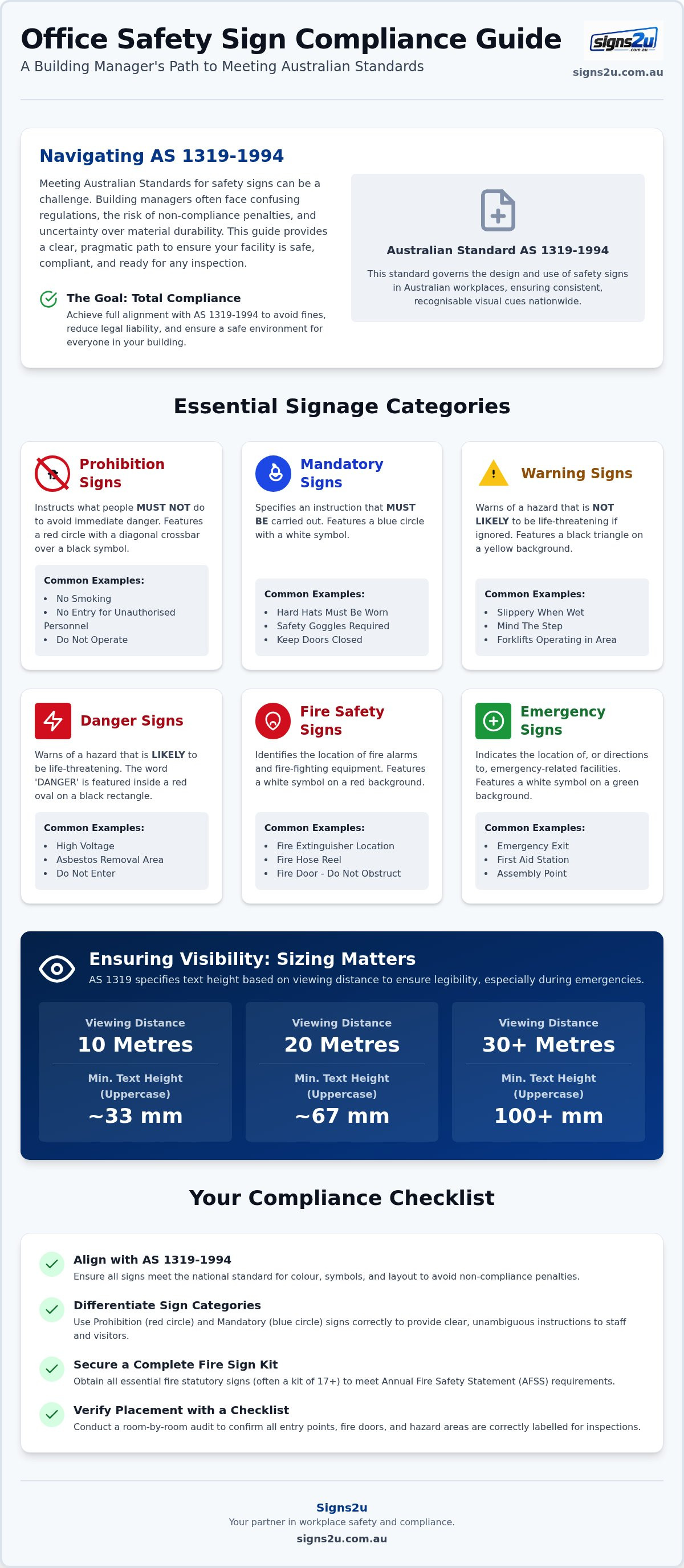
AS1319-1994 sets out specific layouts for different classes of safety information. It categorises signs into groups like prohibition, mandatory, and danger. By standardising colours and symbols, the standard ensures that a red circle or a yellow triangle is recognised instantly nationwide. This consistency is vital for maintaining a safe environment across all Australian office buildings and commercial sites. It removes the guesswork for workers who move between different facilities; the message remains the same regardless of the location.
Why Building Managers Prioritise Statutory Signage
Building managers prioritise statutory signage because it's often a prerequisite for obtaining and maintaining an Annual Fire Safety Statement (AFSS). Without the correct fire statutory signs, a building may fail its certification. Beyond the paperwork, these signs are vital for clear communication during high-stress emergency evacuations. They guide occupants safely through stairwells and towards assembly points when panic might otherwise take over.
Installing the right office building safety signs provides a cost-effective way to mitigate workplace health and safety risks. It's a one-time investment that protects your staff and your business from the fallout of preventable accidents. Instead of complex training manuals, a well-placed sign delivers immediate, actionable information at the point of need. This pragmatic approach keeps your facility running smoothly and keeps your compliance record clean.
Essential Signage Categories for Your Office
Office building safety signs aren't all created equal. They're divided into specific categories based on the level of risk and the type of instruction required. While Australian Standard AS1319-1994 is your primary guide, these categories often align with international best practices and OSHA regulations for safety signs regarding hazard communication. Using the correct office building safety signs ensures that your warnings are legally compliant and easily understood by everyone in the facility.
Danger signs indicate life-threatening hazards, while Warning signs point out risks that could cause injury. For example, a Danger sign might warn of high voltage, while a Warning sign identifies a slippery floor. Emergency information signs use green backgrounds to guide people toward first aid equipment or emergency exits. Getting these right is about more than just colours; it's about providing the right level of urgency for each specific situation.
Fire Statutory and Emergency Exit Signs
These signs are the backbone of your building's emergency plan. Fire statutory signs identify the exact location of extinguishers, hoses, and fire blankets. Without these specific office building safety signs, response times during a fire increase significantly. You must also label fire doors to ensure they remain closed and unobstructed at all times. This is a legal requirement for fire safety certification. Exit signs provide the final piece of the puzzle, offering a clear, high-visibility path to assembly points.
Mandatory and Prohibition Signage
These signs regulate daily behaviour to prevent accidents before they happen. Prohibition signs feature a red circle with a diagonal slash. They tell staff and visitors what they cannot do, such as "No Smoking" or "No Entry" to restricted zones. Mandatory signs use a blue circle with a white symbol to specify an instruction that must be followed. These are vital for areas like plant rooms or server centres where specific safety gear or access protocols are required.
Selecting the right mix of these categories is a pragmatic step toward a safer workplace. It's about utility and clarity rather than aesthetics. If you need to update your facility, you can find a comprehensive range of safety and carpark signage designed to meet these exact standards.
Selecting the right substrate for your office building safety signs is a pragmatic decision that directly impacts your maintenance budget. A sign that peels, cracks, or fades within months is a wasted expense and a potential compliance failure. Longevity depends entirely on matching the material to the specific environment of your facility. Beyond durability, contrast is a critical factor for visibility. A sign must stand out from its mounting surface to be effective. If you mount a white sign on a white wall, its impact is lost. Following best practices for signage means ensuring high contrast and eye-level placement to capture attention immediately.
Indoor vs Outdoor Material Options
Your choice of material should be dictated by the installation site. For smooth indoor surfaces like office doors or plastered walls, self-adhesive vinyl is often the most cost-effective solution. It is easy to apply and stays secure in climate-controlled environments. However, for high-traffic areas or external locations, you need more robust options.
- Polypropylene: Lightweight and rust-proof. This is ideal for undercover carparks and humid areas.
- Metal (Aluminium): Provides maximum durability for exterior walls exposed to the elements.
- Laminated finishes: These protect the print against harsh cleaning chemicals and UV fading, extending the life of the sign by years.
Size and Placement for Maximum Visibility
Viewing distance is the primary factor that determines the required size of your office building safety signs. If a sign is too small, it fails to warn occupants in time. Australian standards provide clear guidelines to ensure text and symbols remain legible from a distance. The general rule for upper-case text is a minimum height of 5mm for every metre of viewing distance. For example, a sign intended to be read from 10 metres away must have text at least 50mm high.
Symbols require even more prominence. They should be at least 15mm per metre of viewing distance to be recognised instantly. In areas with poor lighting or long corridors, increase the sign size by 50% to compensate for reduced visibility. Mounting height is equally important. Always aim for the observer's direct line of sight. This usually means mounting signs at eye level, roughly 1500mm to 1700mm above the floor. Ensure the area around the sign remains free from visual obstructions like plants, furniture, or other non-essential notices.
Office Signage Checklist: A Room-by-Room Guide
Securing a commercial facility requires a methodical walkthrough to identify every compliance gap. Effective office building safety signs follow a logical flow that mirrors how people move through the space. Start at your main entry points. These areas require clear "Report to Reception" or "No Entry" signs to manage visitor flow and security. Without these, you risk unauthorised access to hazardous areas like plant rooms or loading docks.
Fire doors are a critical focus for any safety audit. Every fire door in your building must be labelled with specific statutory text, such as "Fire Door - Do Not Obstruct" or "Fire Door - Keep Closed". These aren't suggestions; they're mandatory requirements for building certification. Similarly, stairwells need floor level identification on every landing. This helps emergency services navigate the building and ensures occupants know exactly where they are during a high-stress evacuation.
Amenities and exits require specialised accessibility signage. Braille and tactile signs are mandatory for all toilets and emergency exits to assist vision-impaired occupants. These signs must be mounted at a specific height and side of the door to remain compliant with Australian building codes. It's a pragmatic step that ensures your office is inclusive and legally protected.
Corridors and Evacuation Routes
Corridors act as the primary path of travel during an emergency. You need directional arrows leading to the nearest exit at every junction. These routes must also feature location signs for fire extinguishers, hydrants, and hose reels. If you're unsure about the specific requirements for your state, refer to our guide on fire statutory signs australia for deeper compliance info. This ensures your office building safety signs meet the precise standards needed for your Annual Fire Safety Statement.
Kitchens and Common Areas
Shared spaces like kitchens present unique risks. You must install fire blanket and extinguisher ID signs near all cooking facilities. These should be mounted high enough to be seen over furniture but low enough to be reachable. Common areas also benefit from hygiene and handwashing reminders near staff amenities to maintain workplace health standards. Finally, ensure first aid kit locations are marked with a green and white cross sign. This allows for quick access during minor accidents or medical emergencies.
Ready to complete your building's checklist? Procure your entire kit of standard-aligned fire statutory signs today to ensure you're prepared for your next inspection.
Buying Statutory Signs Online with Signs2u
Procuring the right office building safety signs shouldn't involve endless phone calls or custom design fees. Signs2u simplifies the process by providing a curated selection of 17 essential fire statutory signs. This collection is specifically designed to meet the rigorous demands of building certification. By sourcing your entire kit from a single online provider, you eliminate the risk of mismatched signage or missing requirements. Our signs are engineered to meet Australian Standards while remaining cost-effective for small-to-medium office builds. This direct-to-customer model bypasses the overheads of traditional sign shops, passing the savings directly to you.
Why Choose Our Statutory Collection?
Our designs prioritise clarity and compliance above all else. We use durable materials that stand up to the daily wear of a standard office environment. Property managers often face tight deadlines for inspections. Our easy online ordering process is tailored for busy professionals who need to get the job done without fuss. You don't need to be a signage expert to secure your site. We provide the tools; you provide the location. Each sign in the collection follows the specific colour and font requirements of AS1319-1994, ensuring you pass your audit on the first attempt. This pragmatic approach saves time and reduces the mental load of compliance management.
Streamlining Your Compliance Procurement
Custom sign shops often introduce unnecessary complexity and long lead times. Our standardised range removes these hurdles. These signs are ready to ship, ensuring your site stays compliant without the wait for custom fabrication. Direct delivery across Australia means your signage arrives exactly when you need it for your next fire safety audit. It's a pragmatic solution for modern building management. Instead of dealing with complex graphic design requirements, you can simply select the signs you need and move on to your next task. This efficiency is vital for maintaining multiple properties or preparing for a sudden inspection. Our focus is on utility, ensuring every office building safety signs purchase is a straightforward transaction.
Shop the Fire Statutory Signs collection now to secure your building and meet your legal obligations with ease.
Secure Your Facility for 2026
Achieving total building compliance doesn't need to be a complex or expensive project. By following a structured room-by-room checklist and selecting standard-aligned materials, you've already handled the hardest part of the process. Remember that the right office building safety signs are tools for utility. They protect your occupants and your business from legal risk. Focus on high-contrast placement and durable substrates to ensure your investment lasts well beyond the next audit cycle.
Signs2u provides the most pragmatic path to meeting these requirements. Our specialised collections meet AS1319 and AS4600 standards, giving you the confidence that every sign is fit for purpose. We focus on cost-effective compliance solutions with direct national delivery across Australia. This ensures you can get the job done quickly without the need for custom fabrication delays. Don't leave your next inspection to chance; take control of your workplace safety today and keep your facility running smoothly.
Order Your AS-Compliant Fire Statutory Signs Online
Frequently Asked Questions
What are the legal requirements for office building safety signs in Australia?
Legal requirements are primarily defined by Australian Standard AS1319-1994 and the National Construction Code. These regulations mandate the use of specific colours, symbols, and layouts to ensure hazard communication is consistent across all workplaces. Building managers must install compliant signage to meet work health and safety obligations and obtain necessary fire safety certifications. Failure to comply can result in significant fines and increased liability during workplace accidents or emergency events.
Do fire door signs have to be a specific size or colour?
Yes, fire door signs must follow strict statutory requirements regarding size and colour to remain compliant. They typically feature white text on a green background or black text on a white background, depending on the specific building code application. The text must be large enough to be legible from a distance, usually with a minimum letter height of 20mm for standard door mounting. These signs must state specific phrases like "Fire Door - Do Not Obstruct".
How often should I inspect or replace my office safety signs?
You should inspect your office building safety signs at least once every six months during standard safety walkthroughs. Signs require replacement if they become faded, cracked, or peeled, as reduced legibility compromises compliance. Environment matters; outdoor signs or those exposed to harsh cleaning chemicals often need more frequent replacement than indoor vinyl. Always ensure signs remain unobstructed by new furniture, equipment, or office renovations to maintain clear lines of sight for all occupants.
Can I use self-adhesive vinyl signs for fire statutory requirements?
Self-adhesive vinyl is acceptable for many fire statutory requirements provided the mounting surface is smooth, clean, and located indoors. It is a cost-effective choice for labelling fire doors or cupboards containing extinguishers. However, you must ensure the vinyl meets the durability and visibility standards required by AS1319. For high-traffic areas or external locations, more robust materials like polypropylene or metal are preferred to prevent the edges from lifting or the print from wearing away.
What is the difference between statutory signage and general safety signs?
Statutory signage is legally mandated by building codes and Australian Standards for building certification, such as fire door or exit signs. General safety signs are used to manage specific workplace risks and include categories like "Caution: Wet Floor" or "Hearing Protection Required." While both are essential for a safe environment, statutory signs are usually a prerequisite for an Annual Fire Safety Statement. General safety signs are often dictated by a company's internal risk assessment.
Where should fire extinguisher signs be placed in an office?
Fire extinguisher signs must be mounted directly above the equipment at a height that ensures visibility over obstructions. This is typically about 2000mm above the floor level. The sign allows occupants to locate the extinguisher quickly from a distance, even if the unit itself is obscured by a desk or partition. If the extinguisher is located inside a cabinet, the exterior of the cabinet door must also be clearly labelled with the appropriate statutory sign.
Do I need Braille signs for toilets in my office building?
Yes, Braille and tactile signs are a legal requirement for all accessible and standard toilets in Australian commercial buildings. These signs assist vision-impaired occupants and must be installed according to the specifications in the National Construction Code and AS1428.1. Placement is critical; they must be mounted on the wall on the latch side of the door at a height between 1200mm and 1600mm to ensure they are easily reachable and functional for all users.
What Australian Standard covers safety signs for work environments?
Australian Standard AS1319-1994 is the primary regulation covering office building safety signs and workplace environments. It specifies the design, use, and placement of signs intended to prevent accidents and communicate health and safety information. This standard defines the symbolic shapes and colours used for prohibition, mandatory, and danger signs. Following this standard ensures that your facility maintains a consistent safety language that is recognised by workers and inspectors across the entire country.